
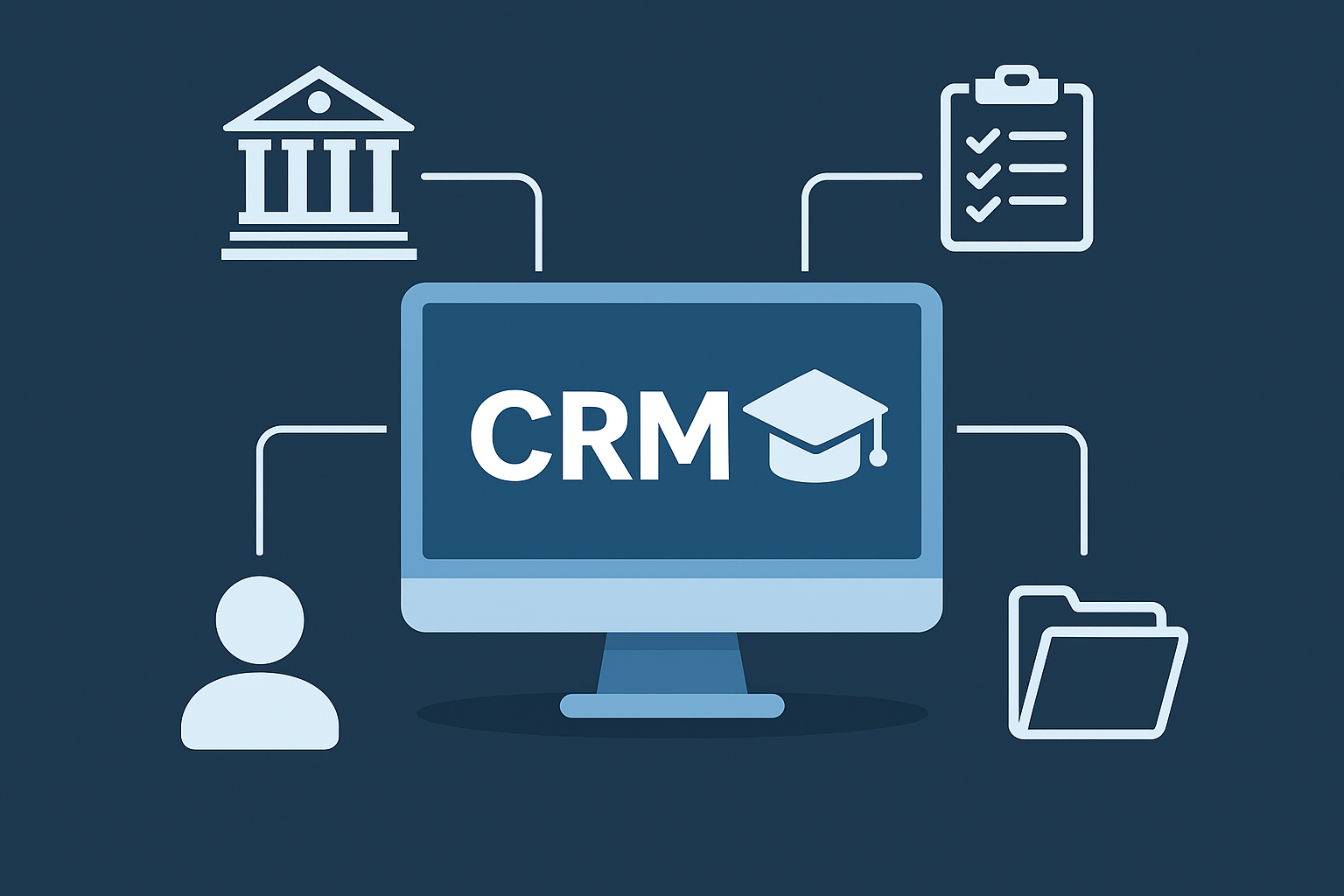
Despite best intentions and significant investments, many CRM implementations in the education sector fail to deliver meaningful results. This isn’t due to technical incompetence or a lack of effort. Often, the real issue lies in a fundamental misalignment between system design and the actual business model of educational institutions. One of the most common, yet overlooked, causes of failure is the attempt to implement CRM systems as if the institution were a B2B company. In this article, we explore why applying B2B logic to education can derail CRM success, and what an education-centric design should look like instead.
1. Why CRM Even Matters in Education
Before diving into CRM design challenges, it’s important to address a common question: “Do schools even need a CRM?”
The answer is a resounding yes—but not in the same way corporations use it.
Educational institutions need CRM systems not to close deals, but to:
- Manage inquiries from prospective students and families
- Track touchpoints and communications throughout the application process
- Understand the effectiveness of marketing campaigns
- Coordinate admissions teams and personalize outreach
- Monitor family engagement and retention over time
Unlike ERP systems which handle internal processes (e.g., class schedules, grades, finance), a CRM is student- and family-facing. It manages the relationship, not just the records.
2. Understanding the CRM Journey in Education
To make the discussion more concrete, let’s outline what a typical CRM journey looks like in an educational context. This helps clarify where CRM fits in, and why structure matters:
Typical Student CRM Journey:
- Inquiry received (from parent or student)
- Student profile created (often including interests, grade level, preferred campus)
- Follow-up communication (email, call, event invitation)
- Application submitted
- Interview scheduled and completed
- Offer extended
- Offer accepted
- Enrollment confirmed
Each step involves multiple interactions, possibly across different departments (marketing, admissions, academic advising). Without a CRM that reflects this flow, data gets scattered and insight becomes unreliable.
3. The Temptation of B2B Thinking
Most CRM consultants and development teams come from a B2B background. It’s what they know best, and many CRM platforms—including Salesforce, Microsoft Dynamics, and Zoho CRM—are built with B2B structures as their foundation. In B2B:
- Leads represent individuals from potential client companies.
- Accounts represent companies.
- Opportunities represent potential contracts or deals.
- Contacts are the people within those companies.
It’s a logical, hierarchical model that works beautifully in enterprise sales environments. But educational institutions are fundamentally different. Students aren’t companies. Families aren’t buying contracts. The product isn’t a service package or software license—it’s a long-term learning experience, often deeply personal and emotionally charged.
Yet, many education institutions still get implemented with B2B logic. This leads to systemic mismatches that snowball into data confusion, poor adoption, and analytical blind spots.
2. Real-World Example: When Parents Become Leads
A common B2B-style misstep in educational CRM design is this: treating the parent as the lead.
Why? Because the parent is the decision-maker, the payer, the one you speak to.
But the student is the one actually engaging with the product. The student:
- Attends classes
- Chooses subjects
- Completes applications
- Progresses through the funnel
By treating the parent as the lead and the student as a secondary contact, institutions end up with inaccurate source tracking (e.g., UTM codes), broken campaign attribution, and dashboards that reflect interest and conversion data for the wrong person.
Moreover, when a family has multiple children, the CRM starts to fall apart. How do you manage individual journeys for siblings? How do you track different programs, interests, and outcomes for each one?
4. Over-Engineering to Compensate for a Faulty Model
Before we go further, let’s clarify the terms “Application” and “Enrollment,” which are often used differently across sectors. In the context of education CRMs:
- Application typically refers to the process in which a student formally expresses interest in joining a program or school.
- Enrollment refers to the point at which the student accepts an offer and is registered into the system.
These terms may be modeled as separate objects in a CRM system, especially when trying to mimic a multi-stage funnel. However, doing so without a proper data strategy often causes more issues than it solves.
When the initial CRM model doesn’t match reality, teams often build elaborate workarounds:
- Creating custom objects like Application, Enrollment, or Status History to represent student steps
- Syncing statuses across these objects manually (e.g., if Enrollment = “Offered” then Application = “Applied”)
- Using hard-coded logic to convert leads into Application records
- Creating data redundancies where student data exists in both the Contact and Lead objects
These solutions are technically clever but conceptually flawed. They create fragile systems that are:
- Hard to maintain
- Difficult for non-technical staff to navigate
- Problematic for reporting and analytics
And worst of all: they distract from the real fix, which is to align the CRM model with the educational journey.
5. B2B Constructs That Don’t Belong in Education
Here are some classic B2B CRM features that often cause more harm than good when blindly applied to education:
a) Parent Account / Child Account
In B2B, this makes sense for multinational corporations. In education, it’s rarely applicable. Families aren’t hierarchies. Campuses are locations, not subsidiaries.
b) Multiple Opportunities per Contact
In B2B, a single company may sign multiple contracts for different departments. In education, each student typically follows one journey at a time.
c) Lead Qualification Logic
B2B leads are scored and qualified before engagement. In education, many leads are exploratory or emotional in nature. Trying to score them the same way leads to poor funnel accuracy.
d) Opportunity Products
While useful for sales packages, breaking down tuition or academic programs into “products” often adds unnecessary complexity without analytical benefit.
6. What an Education-Centric CRM Model Looks Like
To make this shift clearer, here’s a quick comparison of the two models:
| Component | B2B CRM Logic | Education CRM Logic |
|---|---|---|
| Lead | A person at a company | A prospective student |
| Account | A company | A family unit or household |
| Contact | People within a company | Students and guardians |
| Opportunity | A deal or contract | An application/enrollment process |
| Campaign Attribution | Linked to lead/company | Linked to student/contact |
Let’s flip the logic. Instead of forcing education into B2B shoes, let’s model CRM based on how schools actually work.
a) Lead = Student
Even if the parent fills out the form, the lead record should represent the student. Capture parent data as related fields or related contacts.
b) Contact = Student + Guardians
On conversion, create Contacts for both the student and associated guardians. Assign roles such as Guardian, Father, Mother.
c) Account = Family Unit
Group all related contacts under one Account representing the family. This allows visibility of household-level engagement and history.
d) Opportunity = Enrollment Application
Use stages to represent milestones: Inquiry > Interview > Offered > Accepted > Enrolled.
e) UTM / Source Tracking on Student
Campaign attribution and digital tracking should be tied to the student’s journey, not the parent’s.
7. Can You Skip the Lead Object Altogether?
In many cases, yes.
Some educational institutions use a “Contact-first” model, skipping Lead entirely. This works well when:
- You’re mostly dealing with inbound inquiries
- You don’t need to pre-qualify before follow-up
- You want to avoid conversion overhead and keep data centralized
Using custom status fields on Contact can replace lead stages. The key is consistency.
This approach isn’t just theoretical—it’s practiced at scale. For instance, Salesforce Education Cloud, which is specifically designed for academic institutions, completely skips the Lead object. Instead, it treats the Contact as the central entity from the very beginning. Inquiry, application, and enrollment journeys are all tied directly to the Contact, allowing for a more holistic and consistent student record without the friction of conversion.
Salesforce’s design decision here reinforces a broader truth: in education, your journey begins with the learner, not a lead.
This approach isn’t just theoretical—it’s practiced at scale. For instance, Salesforce Education Cloud, which is specifically designed for academic institutions, completely skips the Lead object. Instead, it treats the Contact as the central entity from the very beginning. Inquiry, application, and enrollment journeys are all tied directly to the Contact, allowing for a more holistic and consistent student record without the friction of conversion.
Salesforce’s design decision here reinforces a broader truth: in education, your journey begins with the learner, not a lead.
In many cases, yes.
Some educational institutions use a “Contact-first” model, skipping Lead entirely. This works well when:
- You’re mostly dealing with inbound inquiries
- You don’t need to pre-qualify before follow-up
- You want to avoid conversion overhead and keep data centralized
Using custom status fields on Contact can replace lead stages. The key is consistency.
8. What Happens When You Get It Right
CRM systems that reflect the real business structure unlock:
- Clearer reporting: Cost per student, campaign ROI, yield by source
- Better user adoption: Staff understands what data means and where it lives
- Less technical debt: Fewer workarounds, cleaner data model
- Stronger insight: You can see exactly which audiences, programs, and campaigns are working
It also enables more accurate personalization and follow-up:
- “We saw you were interested in IB” vs. “Your child was tagged in a campaign.”
9. Final Thoughts: Technology Should Follow Truth
CRM design is not just a technical task. It’s a reflection of business philosophy.
When you model your CRM like a B2B pipeline while your business is built on human journeys, family dynamics, and learning outcomes, you don’t just get a bad system—you get bad decisions.
Data becomes distorted. Teams work harder for less insight. Reports become misleading.
It’s time for education institutions to stop copying B2B logic and start designing CRMs that truly reflect their learners.
CRM success isn’t about complexity. It’s about clarity.
And clarity begins with asking the right question: Who is our customer, really?