
And Why Many Companies Are Now Turning to Business Analysts
CRM systems are often expected to revolutionize how companies operate—by making them more customer-centric and data-driven. Organizations around the world, including those in Thailand, pour significant budgets into CRM platforms, hoping to gain deeper customer insights, increase sales, and deliver consistently better experiences.
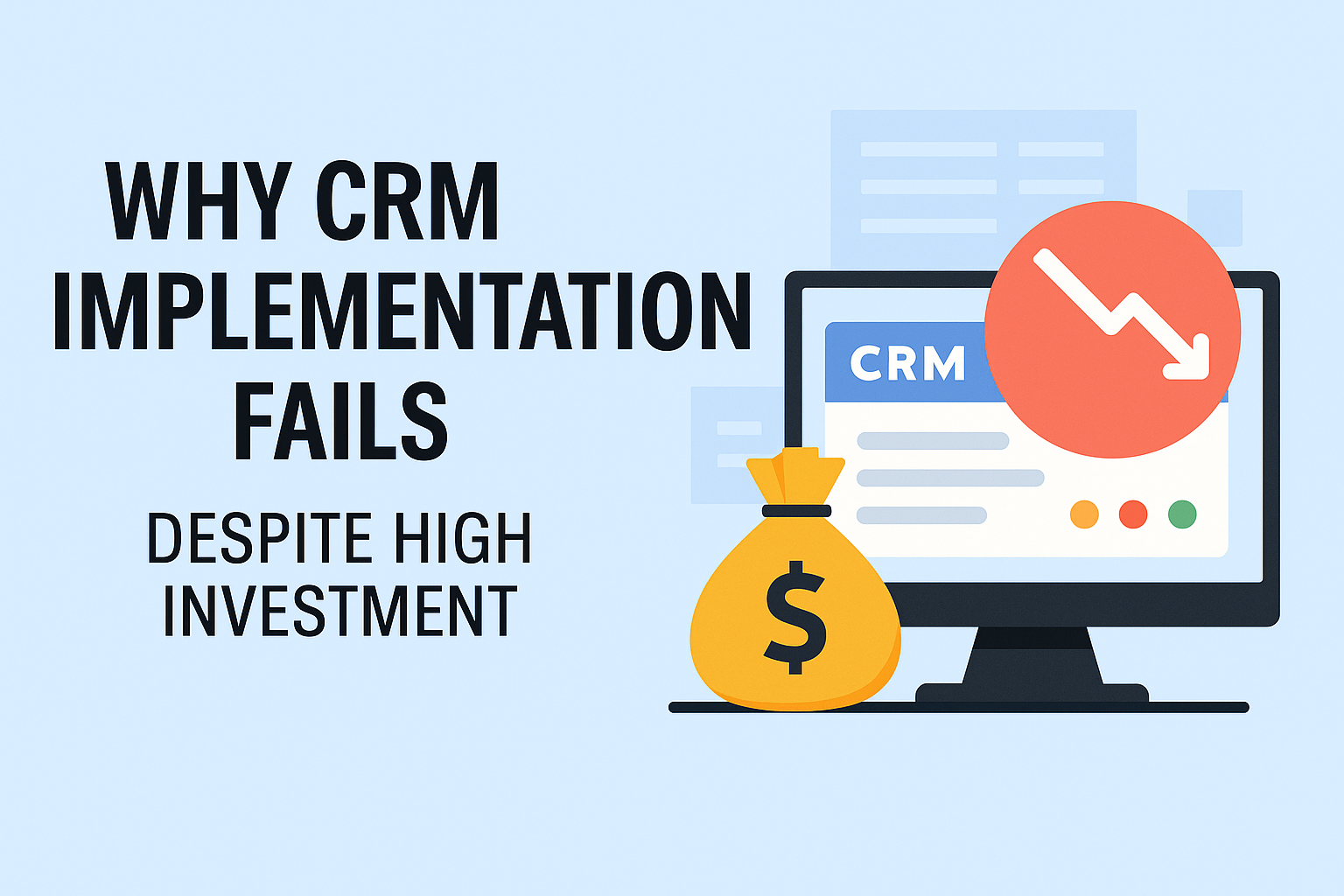
But in reality, studies from multiple sources consistently show that CRM implementations fail at disturbingly high rates—ranging from 20% to 75% depending on how “failure” is defined. This includes an inability to achieve the expected ROI, lack of real system usage, or no tangible improvement in team performance (JohnnyGrow, Bridgerev).
The financial losses involved are massive. Large enterprises typically spend between $30 million and $90 million over a three-year CRM project. Yet despite such high investment, 66% of enterprise software projects exceed their budget, and nearly half deliver 56% less value than initially projected (Forecast.app, Productive.io).
In fact, 48% of sales professionals believe their CRM systems are not fit for purpose, which contributes to customer churn costing mid-sized companies an average of $5.5 million annually (DemandGenReport).
The Key Reasons CRM Projects Fail—Even with Strong Budgets
1. Poor User Adoption
A CRM system is only as good as its usage. Many systems fail because employees simply don’t use them. This happens when the interface is unintuitive, workflows are misaligned with real tasks, or users don’t understand the system’s value. Lack of proper training and ineffective internal communication further worsen the problem. Ultimately, users disengage entirely.
2. Lack of Clear Goals
Many companies embark on CRM projects with vague intentions like “improving sales” or “capturing customer data” without defining measurable outcomes. Without concrete success metrics and a clear roadmap, it’s difficult to evaluate performance, and the project quickly loses momentum.
3. Treating CRM as a Technology, Not a Strategy
CRM is often seen as an IT tool rather than a strategic asset. As a result, teams focus on features and deployment, rather than asking how the CRM aligns with customer behavior or business goals. Without strategic alignment, CRM usage remains superficial.
4. Weak Change Management
Implementing a CRM system is about more than technology—it involves changing mindsets, behaviors, and company culture. Without strong change management (e.g., clear communication, user training, internal champions), resistance quickly builds. Teams fall back to old habits, and the CRM becomes a forgotten platform.
5. Data Quality Issues
CRM runs on data. Outdated, incomplete, or duplicated information leads to inaccurate reports and erodes user trust. Worse, if poor data is migrated from legacy systems without cleanup, it contaminates the new CRM and becomes a long-term liability.
6. Passive Leadership
Executives often approve CRM projects but don’t actively support or promote them. For CRM to succeed, leadership must engage visibly, use the system themselves, and communicate its strategic importance. Without this, employees see CRM as “not mission-critical.”
Where Budget Alone Can’t Save the Project
- Complex Integrations: CRM systems often need to sync with ERP, HRM, billing, and more. Without precise data mapping, integrations break, causing data silos and duplicated inputs.
- Process Misalignment: Many systems are customized based on executive preferences, not actual workflows. The result? Long forms, unnecessary fields, and interfaces that frustrate users.
- Hidden Costs: Beyond software licenses, true CRM implementation requires training, documentation, change management, support staff, and ongoing maintenance. These costs can multiply if not planned early.
So What Can Organizations Do?
CRM success starts with a mindset shift: it’s not a sales tool; it’s a company-wide platform. And it must serve real customer needs—not just internal KPIs.
- Set clear objectives tied to measurable outcomes (e.g., shorten sales cycles, increase retention, reduce duplicate data)
- Design the system based on real user journeys and business processes, not executive assumptions
- Build a comprehensive change management plan with champions, phased training, and user feedback loops
- Assign data stewards and process owners to ensure long-term quality
- Ensure leadership involvement with active usage and communication
Why Business Analysts Are Becoming Essential
More organizations are turning to Business Analysts (BAs) to bridge the gap between management, operations, and IT teams. BAs go beyond collecting requirements—they understand pain points, analyze the root cause of system friction, and recommend business-aligned solutions.
A good BA might notice that sales reps aren’t updating records because the mobile app is too slow, or that the data being collected doesn’t actually influence decision-making.
BAs ask the right questions:
- What behavior are we trying to change?
- Does this field or report serve a real business decision?
- How quickly can we act on a customer inquiry?
With a BA who understands both technology and user context, CRM becomes a value-creating tool—not a burden.
“CRM systems don’t fail because of bad software. They fail because no one nurtures them.”