
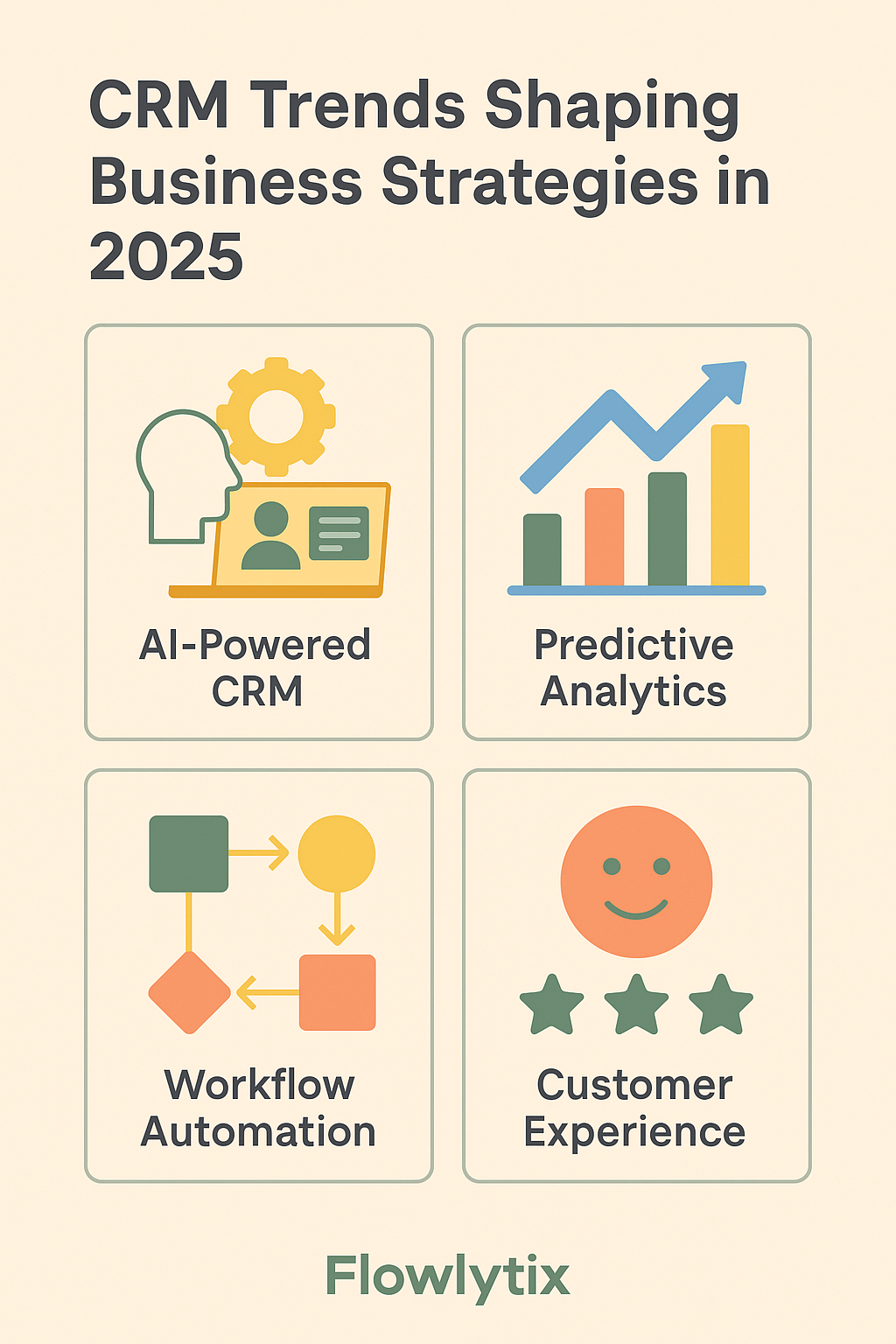
How evolving customer expectations and intelligent automation are redefining business success.
A New Era for CRM
In 2025, CRM is no longer just a system of record. It has become the strategic engine powering modern businesses—intelligent, predictive, and deeply human-centered. Global CRM spending is on track to surpass $98 billion by the end of the year, and some forecasts suggest it may hit $145 billion by 2030. That level of investment reflects not just technological advancement, but a mindset shift: CRM is no longer optional—it is the nervous system of customer-centric growth.
This transformation is being driven by several key forces: artificial intelligence, hyper-personalization, workflow automation, and a global rise in customer expectations. Together, they are reshaping the way organizations build relationships, deliver value, and make decisions.
1. AI-Powered CRM: From Insight to Impact
Personalized at Scale
AI has become the quiet revolution behind today’s most effective CRM strategies. No longer limited to chatbots or basic automation, modern CRM systems now analyze behavioral signals, contextual data, and customer journeys in real-time. This enables what was once impossible: personalization at scale.
Instead of generic campaigns, companies are delivering experiences that feel tailor-made. AI interprets intent, predicts next actions, and suggests the best way to engage—whether it’s product recommendations, personalized email flows, or dynamic content on a landing page. It’s not just smarter marketing—it’s deeply human marketing, powered by machines.
Predictive Intelligence
Predictive analytics has moved from buzzword to baseline. In 2025, CRM platforms are expected to deliver real-time insights into which leads are likely to convert, which customers are at risk of churn, and which offers are most likely to drive engagement. These insights allow businesses to act proactively, designing experiences that align with both intent and timing.
It’s not about replacing intuition—it’s about reinforcing it with real data, so teams can focus on high-value activities that build lasting relationships.
2. The CRM Market: Accelerating with Purpose
Growth Anchored in Value
The CRM market isn’t just growing because technology is improving. It’s growing because the expectations placed on businesses are higher than ever. Today’s customers want instant answers, personalized journeys, and meaningful interactions. CRM platforms have become the go-to infrastructure for delivering all three.
Investments are no longer driven by tech enthusiasm alone. They’re strategic decisions aimed at improving business resilience, responsiveness, and relevance in an uncertain world.
Regional Dynamics
North America continues to lead in innovation, with platforms like Salesforce and HubSpot integrating AI, automation, and advanced analytics as standard features. Europe, shaped by strong privacy regulation like GDPR, shows preference for compliance-ready systems. Meanwhile, Asia-Pacific stands out as the fastest-growing CRM market, driven by rapid digitization in countries like India, Indonesia, and Vietnam.
This global diversification signals one thing: CRM is not a one-size-fits-all solution. The best platforms of 2025 are those that balance global capability with regional sensitivity.
3. Customer Expectations Are the New KPI
The Risk of a Single Bad Experience
According to the latest report by Qualtrics XM Institute, one negative experience is now enough for one-third of customers to walk away—entirely. That statistic underscores a powerful truth: customer loyalty is fragile, and expectations are rising fast.
CRM has become the front line in this battle. By integrating engagement data, support history, and customer sentiment, modern systems can now anticipate frustration before it escalates. Proactive outreach, intelligent service routing, and emotionally intelligent automation are setting a new standard for what good service looks like.
Beyond Segmentation: Hyper-Personalization
We’re now past the era of segment-based messaging. In 2025, CRM allows businesses to deliver experiences that respond to individual needs, in real time, across multiple channels. This includes behavioral-based content, dynamic product recommendations, and individualized loyalty journeys.
Hyper-personalization isn’t about being clever. It’s about being relevant—and relevance is what keeps customers coming back.
4. Workflow Automation: Doing More With Less
From Manual to Magical
Automation has always promised efficiency. But in 2025, workflow automation delivers more than saved time—it delivers organizational agility.
Modern CRM platforms empower non-technical users to build complex workflows using no-code or low-code builders. Sales processes, onboarding sequences, follow-ups, and even cross-functional approvals can now run automatically, freeing teams to focus on strategy and relationship-building.
Collaboration Without Silos
Today’s CRM is no longer a sales-only tool. It’s a shared workspace where marketing, service, operations, and finance teams collaborate around the customer. Real-time dashboards, shared activity timelines, and unified customer records ensure everyone is aligned—even if they’re halfway around the world.
5. Privacy-Forward CRM: Trust Is the Real Currency
Navigating Complex Regulations
With expanding legislation in both the US and EU, compliance is no longer a checkbox—it’s a core system requirement. Organizations now look for CRM platforms that offer robust consent management, data residency options, and privacy-by-design principles.
Turning Privacy Into a Value Proposition
Customers today are privacy-aware, and many actively reward companies that demonstrate transparency and respect for their data. Advanced CRM platforms now include features like real-time permission tracking, anonymized reporting, and customizable data retention settings.
Trust has become the most valuable currency in customer relationships. CRM systems are central to earning and maintaining it.
The Flowlytix Perspective
At Flowlytix, we believe CRM isn’t just about tools. It’s about thinking. It’s about reshaping the way we approach connection, service, and loyalty in a world that’s more complex, more digital, and more human than ever before.
The trends we see in 2025 are more than temporary shifts—they are signals that businesses must move from reacting to anticipating, from generalizing to personalizing, and from storing data to generating insight.
We don’t claim to have all the answers. But we are committed to asking better questions—and helping teams across industries use CRM not just as a platform, but as a partner in long-term growth.
Let’s build relationships that matter. Let’s make CRM more human, together.



The evolution of CRM into a predictive, intelligence-driven platform really resonates. I’m curious how businesses will balance automation with maintaining authentic human connections—especially as customer expectations keep rising.
It’s interesting to see how AI has evolved from simple automation to driving real-time, intent-based personalization at scale. One challenge I see, though, is ensuring that as CRM systems become more predictive and automated, they don’t lose the human touch that builds authentic customer trust. How do you see brands balancing hyper-efficiency with genuine connection?
The rise of AI-powered CRM systems is a game-changer. By understanding customer behavior in real-time and predicting their next move, companies can deliver far more relevant experiences—this is how brands will stay ahead in 2025 and beyond.
It’s clear that customers’ expectations are rapidly evolving, and businesses will need to get even more agile to stay ahead. I agree that CRM is no longer just about managing relationships, but really anticipating customer needs before they even express them.
I really like how this post highlights the shift from CRM as a static database to an adaptive, intelligence-driven system. The point about AI enabling personalization at scale really resonates—especially as customers now expect brands to anticipate their needs rather than just react. It’ll be interesting to see how companies balance this predictive power with maintaining genuine, human-centered connections.
It’s crazy how much CRM is changing. The AI stuff is wild, and the bit about hyper-personalization makes total sense.