

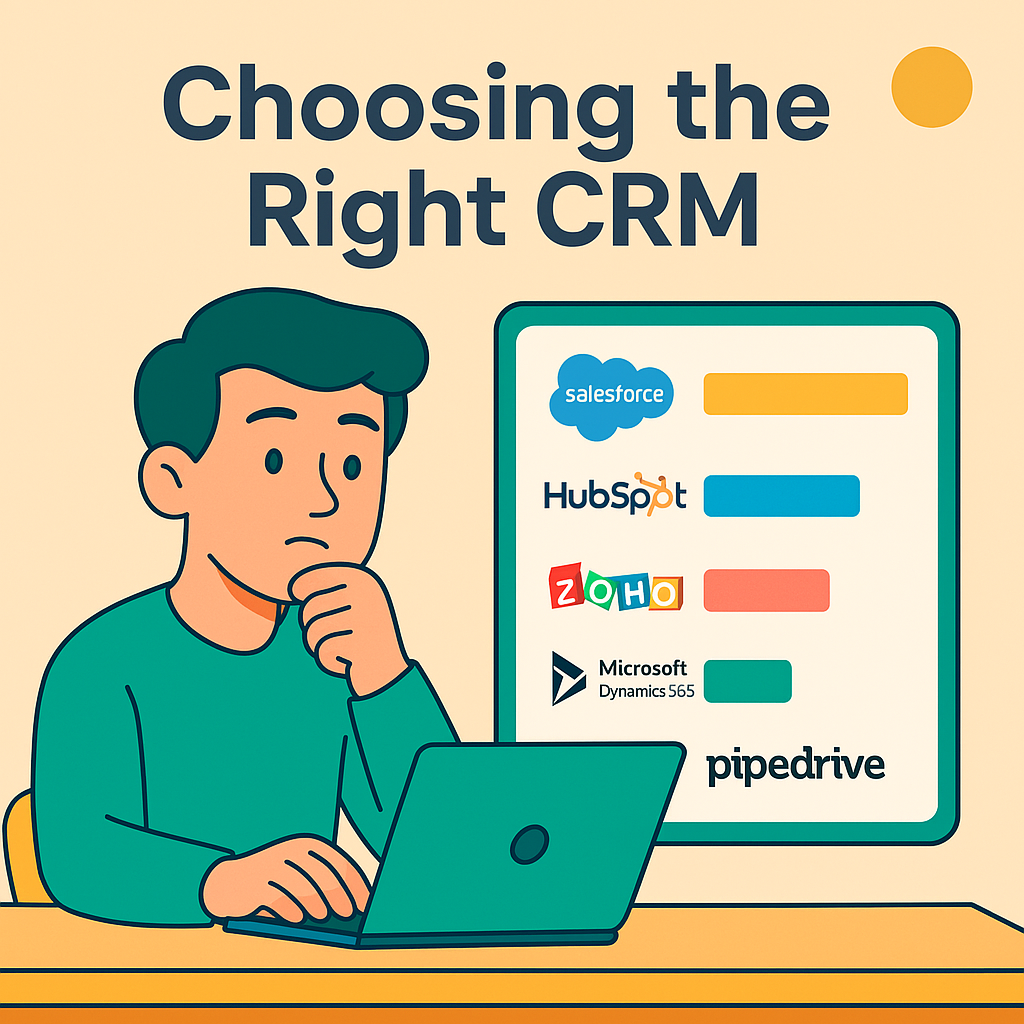
At Flowlytix, we believe there’s no one-size-fits-all CRM. Each platform comes with its own philosophy, design bias, and strengths that align with different kinds of organizations. The key is not which CRM is “best,” but which one supports your growth journey with the least friction and the most clarity.
Here’s a grounded comparison of five of the most widely-used CRM systems—Salesforce, HubSpot, Zoho CRM, Microsoft Dynamics 365, and Pipedrive—through the lens of real-world implementation.
1. Salesforce: Built for Scale, Designed for Customization
Salesforce is a blank canvas with enterprise-grade power. Its flagship, Sales Cloud, is the foundation, but the ecosystem expands quickly: Service Cloud, Marketing Cloud, Experience Cloud, and more.
- Where it shines: Organizations with layered sales processes, regional structures, or advanced reporting needs
- Reality check: Implementation requires skilled admins or partners. Flexibility comes at the cost of simplicity.
- Use it if: You’re building for scale, and you have the resources to design your own system architecture.
2. HubSpot: The Inbound Marketer’s Playground
Originally a marketing platform, HubSpot grew into a full CRM suite—Marketing Hub, Sales Hub, Service Hub, and more—without losing its user-first approach.
- Where it shines: Startups and B2B teams where marketing and sales are tightly integrated
- Reality check: As you scale, key features (especially in Marketing Hub) can drive up the cost sharply.
- Use it if: You want fast onboarding, intuitive UI, and a system that supports inbound growth from day one.
3. Zoho CRM: Quietly Comprehensive, Surprisingly Agile
Zoho CRM may not have the marketing buzz of others, but its combination of affordability, cross-app integration, and steady development make it a serious contender—especially for SMEs.
- Where it shines: Teams looking for a wide toolbox—CRM, campaigns, finance, service desk—all under one ecosystem
- Reality check: The interface and support experience vary depending on your region and plan.
- Use it if: You want solid functionality across the board without committing to enterprise pricing.
4. Microsoft Dynamics 365: CRM Meets ERP, Seamlessly
For organizations deep in the Microsoft ecosystem, Dynamics 365 offers a modular approach: CRM apps for Sales, Marketing, Customer Service, and ERP modules like Finance & Operations.
- Where it shines: Enterprises managing both customer and operational data under one roof
- Reality check: Implementation is not light-lift. Best results come when paired with Microsoft tools like Power BI and Azure.
- Use it if: You’re already using Microsoft products and want centralized data architecture without silos.
5. Pipedrive: Simplicity That Closes Deals
Pipedrive doesn’t try to be everything. It’s a sales CRM first, built for reps who live in their pipeline.
- Where it shines: Small sales teams that want clarity, speed, and fewer distractions
- Reality check: Limited native tools outside of sales—most add-ons cost extra.
- Use it if: You want to start quickly and focus purely on managing deals without the noise.
Quick Reference: Signature Strengths
| CRM System | Best Known For | Practical Advantage |
|---|---|---|
| Salesforce | Sales Cloud, Marketing Cloud, Service Cloud | Enterprise-grade flexibility & depth |
| HubSpot | Marketing Hub, Sales Hub | Intuitive for content-driven teams |
| Zoho CRM | CRM + Zoho One ecosystem | Best value across multiple business tools |
| Dynamics 365 | Sales, Marketing, ERP modules | Unified data across CRM & operations |
| Pipedrive | Visual pipeline sales CRM | Deal-focused with a clean, simple UI |
The Flowlytix Perspective
Don’t let features alone dictate your CRM choice. Think about how your team actually works. How decisions are made. How data flows across departments. The “best CRM” is the one that people actually use, with just enough structure to support growth, and just enough flexibility to evolve with you.

It’s refreshing to see a CRM post focus on real-world implementation. The way Salesforce’s complexity and customization needs were balanced against its scaling potential really hit home for me. Organizations definitely need to match their CRM to their specific needs, not just the features.
The point about each CRM having its own ‘design bias’ really resonated. It’s a smart reminder that you’re not just choosing features—you’re also adopting a certain way of working, which may or may not fit your team’s rhythm.
I love the focus on matching a CRM to an organization’s unique needs. It’s clear that as companies grow, their CRM requirements evolve, and what works in the early stages may not scale as effectively.
I really like how you framed CRMs as tools with different philosophies rather than ranking themBlog comment creation as ‘best or worst.’ In my experience, the friction usually comes from mismatched expectations during implementation—companies often underestimate the internal resources needed to get the most out of a platform. Your point about aligning the CRM with an organization’s growth journey really resonates, because that alignment often determines whether adoption sticks long-term.
I really appreciate the nuanced take on each CRM’s fit for different teams. Salesforce’s scalability is definitely an advantage for larger organizations, but without the right expertise, it can become more of a burden than a blessing. HubSpot’s simplicity is perfect for startups, but as you scale, the need for more flexibility can become a challenge.